01 / A local judge inside a coding agent
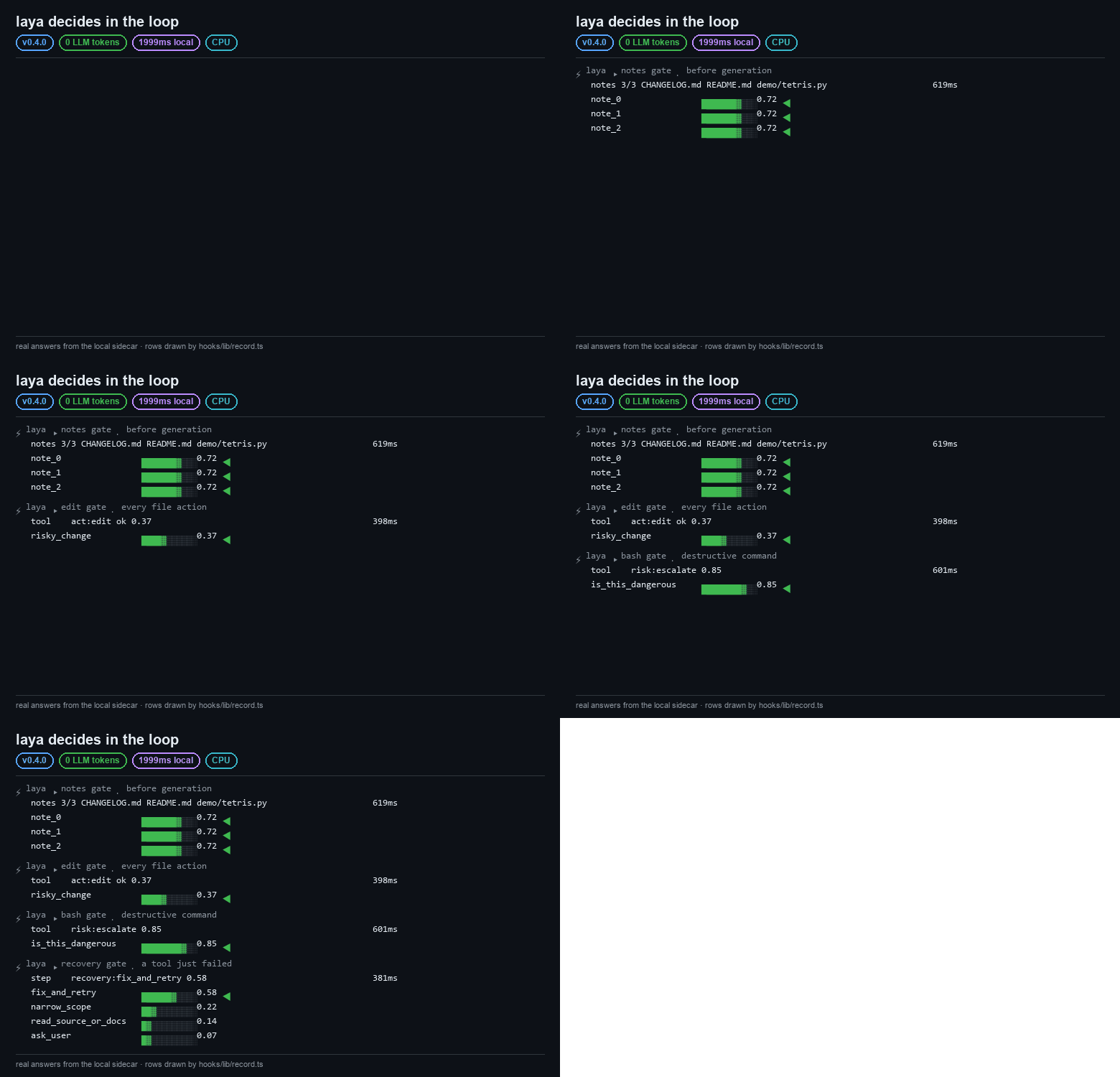
Project: F0Rextasy / omp-laya-judge. A local sidecar supplies typed judgments to an oh-my-pi plugin, including routing and review gates.
The project reports 10/12 on a small integrated test, with mean latency 402 ms (p50 238 ms, p95 1,108 ms) on CPU. Two arithmetic cases are handled by deterministic code; the English checkpoint alone scored 8/12. The reviewed summary does not specify the exact CPU model.
Its broader 56-case comparison gives English Laya 33/56; all three compared backends scored 0/7 on the Turkish subset. This is a concrete integration example with useful failure cases, not production reliability evidence.
02 / Jev chooses browser actions; an LLM writes text
Project: browser-use / jev-ultrafast. Jev selects an operation and a page element. A separate language model supplies text when the chosen operation needs typing.
The README reports a verified Google Flights run lasting 7.073 seconds, with a video at normal playback speed. Timing begins after the first page observation and includes subsequent model calls, generated text, browser work, and loading waits.
In six alternating runs, each of two runtime versions passed 3/3, with median time moving from 9.450 to 7.092 seconds. That is three repeats of one task per version. It does not establish broad browser-agent success rates.
Watch the Google Flights demonstration
See the original MP4 alongside the code and measurement boundaries.
Open the original video ↗This integration also uses a text model, so its total cost cannot be calculated from Jev’s price alone.
03 / A diagnostic for workplace message routing
Project: Adkid-Zephyr / chinese-workflow-decision-bench, also archived in Laya’s repository. It classifies synthetic Chinese messages into urgent, todo, valuable, and noise.
Frozen cases, raw model responses, prompt definitions, and an offline audit script are published. This makes the project more useful to inspect than a hand-picked screenshot alone. The dataset remains small and synthetic.
Sources & review notes
Source review: September 27, 2026. Product documentation can change. Atlas has not rerun model inference. Third-party measurements, where included, are attributed to their authors.
- omp-laya-judge — community integration, animation, and test limitations
- jev-ultrafast — demo recording and performance notes
- Chinese workflow diagnostic — synthetic fixtures with archived model calls